Thursday, 25 June 2009

Book Review: Winter in Madrid

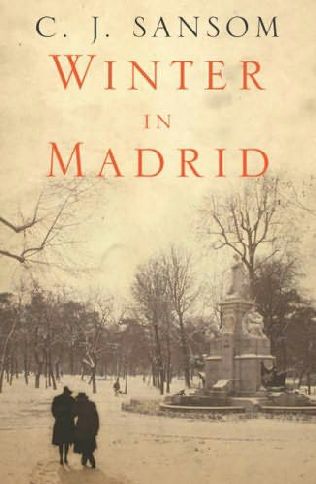
Winter in Madrid, by CJ Sansom

What do you do if a student of yours - whom you respect and whose company you enjoy, mind - gives you a present? Why, you express your gratitude and make use of it, of course. Now, here's the conundrum: what if that present is a book you've never heard of, and which upon reading the first chapter you know you will dislike? I'll tell you what I did. I soldiered on out of respect for the fact that someone cared enough to think of me and part with his money to show it.

After reading this book, I now know I have a lot of respect.

Where do I begin? The clichéd use of an historical setting for a love story? The predictable plot? The charicatured portrayal of English and Spanish alike? The unnecessary descriptive language? Or the fact that it was just boring?

Europe. 1940. Dunkirk veteran Harry Brett is called on by His Majesty's Government to spy on his old schoolmate Sandy Forsyth, who appears to be profiting from the Fascist regime in Franco's newly-established Spain. Britain wants to keep Spain out of the war, and if they can find anything which they can use against the Spanish Government they will. Meanwhile, Sandy's commonlaw wife Barbara Clare is looking for her missing-believed-dead ex-boyfriend who was an International Brigadier fighting for the Republic, and who is being held illegally in a concentration camp on the outskirts of the city. Love, war and politics merge in this unexciting wannabe epic which smacks of mundanity.

The main sensation, while struggling through the dull prose, was that of having seen, heard and read it all before, and by far more capable writers. The plot works to a love-story-in-times-of-war-by-numbers format, and Sansom seems to delight in describing every last detail of war-torn and impoverished Madrid to remind us that 1) this is history; 2) this is grim; and 3) Franco was bad. Apart from such simplistic setting, the reader finds himself not caring one iota for any of the characters: are we really expected to believe that Bernie, Barbara's republican lover, fell in love withher after a week? Then Sansom has the tumerity to repeat the rapidity of feeling between Harry and Sofia, his Spanish girlfriend.

Don't even get me started on the nationalistic representations. I can only hope I missed the surely ironic references to stiff-upper-lipped english diplomats and military types, haughtily efficient Germans, and sadistic Spanish concentration camp officers, or fierce and fiery Spanish women. It's like the literary equivalent of watching a poorly-made propaganda film. Sansom also enjoys reminding his readers that the characters are spanish by littering their speech with familiar phrases in the language. My personal favourite was his liberal use of the term "Madre de Dios", prefixed before most sentences, regardless of which particular Spaniard was supposedly speaking. The only really interesting character was the main antagonist, amoral and greedy Sandy Forsyth, who manipulates everyone around him by playing on their insecurities and using them to advance his own financial status.

Nevertheless, I was entertained by the book, not least because I recognised so many clichés. It almost got to the stage in which I was enjoying how badly it was written. Almost. The "shock" ending is somewhat satisfying, denying the reader the entirely happy ending he so richly deserves; but even this is a familiar technique of historical novels, and it is at this point the novel finally falls into the trap of thinking more of itself than it really is. So, everyone is left unhappy (or dead, in one particular sequence which can only be described as disturbingly Tarantino-esque) but Sandy, who worms his way back into the UK under the guise of an argentine businessman? Yeah, right...

The quote on the cover (from The Daily Express, no less) boasts that "[i]f you like Sebastian Faulks and Carlos Ruiz Zafón, you'll love this". I can't work out who should be most insulted: the authors cited for having their names associated with this drivel; the reader for being so fooled; or Sansom himself for having his ego stroked in such a manner one wonders if this is some sort of joke he has failed to get. Unless you have to, don't read this book.

No Stars.

Film Review: Im Winter ein Jahr (Last Winter)

Karoline Herfurth in Caroline Link's Im Winter ein Jahr (Last Winter, 2008)

I wonder if anyone remembers Robert Redford's film Ordinary People, about a middle-class American family who lose one son in a boating accident and the other son suffers from a painful survivor guilt which pushes him to attempt suicide on various occasions? If you haven't seen it, you should: it won an Oscar, so it must be good, right?

Earlier this month, my housemates and I went to watch Caroline Link's Im Winter ein Jahr (Last Winter) which was being shown as part of the 11th annual German Film Festival in Madrid. Pretty much after ten minutes I was thinking about Redford's piece. This is by no means an imitation: several differences mark this film out as a far more chilling story. However, the idea of how a family reacts and attempts to move on after the death of one of its members is central to the action, characterisation, emotional weight and the themes of loss and unity.

All the actors were phenomenal. Karoline Herfurth sublimely plays Lilli Richter as the surviving sister who wrestles with her grief and resentment against her brother, Alex's, inexplicable suicide. Herfurth drifts through the film in a state of indifference to everything round her, while her on-screen relationship with Josef Bierbichler's Max Hollander, an artist commissioned by Lilli and Alex's mother, Elaine.Corinna Harfouch is possibly the actress in the film most reminiscent of Mary Tyler Moore's mother character in Ordinary People. Unable to come to terms with her loss, and failing to repair an already strained relationship with her remaining child, Harfouch elegantly projects the fragility of her character without seeming obvious or overtly cold. At one moment, when she lays into her husband out of the blue, she repeats the same phrase - "you pushed him too hard" - with so many subtle differences, one feels she cannot escape the inner torment she must feel.

One final mention ought to go to guest actor Misel Maticevic, who plays Lilli's brief fling Aldo, and who manages to make himself utterly hateful within the span of a few seconds, after being so utterly charming for ten minutes. Of course, any good actor is capable of a shift in tone and mood, but to hide a second character beneath that of his character's own creation takes a skill which Maticevic doubtlessly has and which he impressively employs.

Im Winter ein Jahr is not a happy film: it is dark and tragic, but the ending evokes such a life-affirming sentiment one might be forgiven for thinking it a feelgood film upon leaving the cinema.

Five Stars

Also: Celuloidiva , Harald Schleider (2008)

This short film was shown before the main feature, and was an homage to the great film divas and starlets of the Hollywood "Golden Age". A fun ten minutes was had identifying the actresses and the films in which they performed, and the audience was reminded of several great lines. My personal favourite was Mae West's "When I'm good, I'm very good; but when I'm bad, I'm better."

Four Stars

Book Review: El cartero de Neruda (Neruda's Postman)

El cartero de Neruda (Neruda's Postman), by Antonio Skármeta

My keen readers may remember I had breakfast with a genius a while back. Well, he and I weren't alone, it was a class, and it was 11am, but you get the picture. The next day I went out and bought a cppy of his own recommended favourite novel. I finished it within two weeks (yes, late Sanya strikes again). The words "Bloody", "Good" and "Read" come to mind.

Let's push the fact that I'd happily chat with the author until Armageddon to one side. Let's also try and pretend my criticism isn't highly biased based on such admiration. The book is still very good.

It's all about poetry, you see. Specifically, the poetry of Pablo Neruda, and how it affects a group of provincial islanders in a remote corner of Chile who make up the poet's neighbours. Through the eyes of the fictional youth Mario Jiménez, we meet an older Neruda: fat, tired, lazy but not disillusioned. Ready to allow himself to be pestered by the young postman who has never heard of him, Neruda teaches Jiménez the ways of the world: how to enjoy life, how to seduce the object of his affection, Beatriz, and run rings around her mother, doña Rosa; and of course how to read and write poetry. Set against the political backdrop of the election of Salvador Allende's socialist government and the resulting coup d'etat headed by General Augusto Pinochet, the novel deals with life, love, growing up and political upheaval.

The pervading tone of the book is that of admiration and wonder. Jiménez is intelligent but naïve, and is drawn to "don Pablo" because of the latter's unwavering belief in the power of youth. Upon learning in the prologue that Skármeta himself met Neruda when a young journalist, the paralells between the reactions of Jiménez to the man and the author's own are no surprise. Apart from the authority that such knowledge lends to the portrayal of the poet, Skármeta is perfectly capable of avoiding any hero-worship (unlike your poor reviewer). Neruda may be a great poet, and a friendly man, but this reader had the sensation that, perhaps because he was nearing the end of his life, the character of Neruda was that of someone who saw life as a game. He indulges Jiménez because he is bored, and the postman is one of the few people around who hasn't heard of him; when he tires of the game, he is visibly irritated, but by this time, he is still capable of evolution, and comes to embrace Jiménez' presence as if he were his own son. Indeed, the similarity between the mentor/prótege and father/son relationships does not go unnoticed, even within the narrative.

As far as the language is concerned, it is unsurprisingly poetic. The setting of Neruda's home in La Isla Negra, a fishing port, allows for the use of the sea and the isolation of the location for several metaphors: the sea as a means of achieving liberty; the movement of the waves juxtaposed with the frantic fumbling sex Mario has with his lover; the geographical, cultural and political distance of the setting from Santiago, the capital. Certainly, knowledgable readers are constantly aware of the political goings-on which surround the novel's events, but Skármeta manages refer to it without focussing on it or the effects it has upon the characters until the very end, soon after Neruda's own death. Of course, the tragic ending is a direct consequence of the coup d'etat, but one is not left with a political tract upon closing the book.

Engaging, charming, and at points very funny (doña Rosa is the most grotesque stereotype of a hispanic woman of a certain age, and a mother-in-law to boot), El cartero de Neruda is an excellent novel. Short, too, at only 130-odd pages, if you can find this in English, it is well worth getting yourself a copy. Otherwise, learn Spanish: it will be worth it.

Five Stars.

Friday, 19 June 2009

"Honey, I'm Home!"


Fred Flintstone (but, of course you already knew that...)

Well I'm finally back from exams and essay-writing. Did you miss me?

Once I get my results, in a week or so, my spanish university experience will be well and truly over, and I'll be forced to think about the academic future: my gradutation year at university looks like I'm in for some fantastic reading, but also lots of hard work. One of my freinds who has just finished described writing her end-of-degree dissertations as "a test of character"; and this coming year will not be the type of test you find on Facebook, that's for sure. Furthermore, the year will count for 50% of my entire degree! Half! That's a very big chunk of four years' worth of progressive study. I'm determined to get a good grade, so it will be a matter of applying myself or failing after all that time and energy spent on it.

Being in university in Spain has been a very interesting experience. As a foreign student, I've probably had a very different experience to that of my spanish counterparts, but living here as a student has certianly given me an insight into life here in general.

Anyway, this is all stating the obvious, and I haven't much more to say on the matter, really, since I'm not back home yet and won't be for a while. I leave Spain in late August or early September, and I'm looking for a few people who want English lessons, to prop up my bank balance while I'm here. Don't think it'll be all lazing in the sun on beaches: Madrid doesn't have any beaches, anyway, so I'll have to go to my friends' places in the coastal towns and cities. I intend to make full use of my remaing months here, and you can all expect to seeregular updates and commentary on my mundane little life.

Happy, now...?

Saturday, 6 June 2009

A Sign of the End Times?

Life Imitates Art?

I hate the TV series Lost. I think it's an insult to its viewers. Apart from being a conceptual rip-off of the far superior Lord of the Flies, written by William Golding in 1954, it makes for what I like to call "Thrill TV". It provides the thrills, without the need for thought; or provokes pseudo-thought. I mean, come on: a plane goes missing somewhere over the Pacific Ocean, and crash lands on an island, stranding its survivors on a deserted island, on which they must face their fears and their true natures? Who'd even believe that happening, nowadays, anyway...?

And then, all of a sudden, it actually happens: a commercial aircraft goes missing while in flight! No record of how it happened or where it could be now. Even the debris found near the suspected crash site turned ut to be totally unrelated.

We all know I'm not a religious man, but I am a little superstitious at times, letting my fear of the unknown get the better of me. I can't help but wonder what caused this mystery. My grandmother would say it was God's way of reminding us of his existence. Or something. Personally, I think this is some terrible - potentially tragic - mistake. Let's not forget that, unlike in Lost, there were actual people on that flight, and each of them has relatives and friends fearing for their safety.

I just hope this is resolved as soon as possible; and when it is, some very serious questions will need answering.

However, let's not give up on the airline industry just yet (goodness knows they need our help): as Superman reminded us after saving Lois Lane in the first and latest films, statistically speaking, flying is still the safest way to travel. Then again, as Kenneth Williams' character says at the end of Carry On Up the Khyber, I dunno though...

Goodbye, Mr Carradine

David Carradine, actor. Born 8th December 1936; Died 4th June 2009

Two days ago, the actor best known for his roles in 1970s cult TV series Kung Fu and the two Kill Bill films was found dead in his hotel room in Bangkok. David Carradine had a career which lasted over four decades.

Best known for playing Kwai Chang Caine, a Shaolin monk wandering the American west, and more recently Uma Thurman's former-lover-turned-nemesis, Bill, Carradine clocked up performances in over 200 films and television series. Though never a star, he was always working, and was respected by many in the film and television industry.

You can read the BBC News report of his death here, and The Guardian's obituary here.

Mr Carradine, you will be greatly missed.

Goodbye, Ms La Rue

Danny La Rue, entertainer. Born 26th July 1927; Died 31st May 2009

Six days ago, Britain's best-known, and arguably best-loved "comic in a frock", hung up his dresses for the last time.

Danny La Rue made drag performance "acceptable" (not that it ever needed to be accepted, of course) by a mainstream audience, reminding them that, for all his glamour and style - not to mention his humour - he was indeed a man in woman's clothing and make-up. He was a true inspiration for later performers such as Lily Savage.

Read all about Ms La Rue's success in the Guardian's tributes to him: the report of his death is here; his obituary is here; Michael Billington's summary of his style here; and a life of performance in photographs here.

Ms La Rue, you will be greatly missed.

Goodbye, Ms Dean

Elizabeth Gladys "Millvina" Dean, youngest survivor of the sinking of the Titanic ocean liner. Born 2nd February 1912; Died 1st June 2009

Five days ago, the youngest and last remaining survivor of the sinking of the Titanic died peacefully in her home. Elizabeth Gladys - known by many as "Millvina" - Dean was only a few weeks old when her family decided to up sticks and leave the UK for the USA. They chose to sail on the maiden voyage of the Titanic ocean liner.

You can read the BBC report of her death here.

Ms Dean, you will be greatly missed.

We Love Pussy!

Click on the image to be redirected to PUSSY's blog

It isn't everyday an old friend invents a magazine named after an affectionate term for cats.

So, imagine my surprise when I discovered on my Facebook feed that my one-time partner-in-crime at Sixth-Form (pre-university school, for you non-UK-ers), Helen Gibson declared herself Editor-in-Chief of the new PUSSY Magazine.

Now, I wish I could tell you why you ought to have a look at the site, but it might be better - and easier - for you to simply click on the links above and to the left of the posts, or click here for redirection.

All I can say is that, if you knew Helen, you'd know this came from her head. Enjoy...

Hold the Front Page! Homophobic Rapper Gets Ass in Face!

Watch the Saga in All its Ass-Face Glory!

The famous prank-filled MTV awards did it again. I wonder how much planning went into getting an intelligent straight satirist who impersonates a gay television presenter to "accidentally" land on top of a well-known rapper in a 69 position in such a way as to have his bare bottom directly in front of said rapper's face. According to Perez Hilton, of all people*, the "hitch" was indeed a stunt, but one wonders what the aim of the MTV people was.

Of course, the whole thing looks staged - the landing was far too clean and slow enough to avoid any health and safety issues - but how does Eminem benefit from it? He has made his views on homosexuality clear enough over the years, and we all know Bruno is a character creation of a provocative performer who often goes out of his way to show up the prejudices of those surrounding him. Looking at Eminem's face, I don't get the impression he is particularly enjoying the ordeal. After all, he stormed off in a huff after the event. Which leads me to two conclusions.

First, if the stunt were completely accidental - or if Eminem had no idea of what was about to happen - then he comes off as looking just like possessing that humourless self-important ego we all expect such famous people to have. Eminem, known for satirising other performers and public figures in his songs and videos, can't take his own medicine.

However, if he was in on the joke, how does Eminem look like a good sport? He still swears, grunts and looks disgusted at the idea of an ass in his face; and his bodyguards are still rough with Cohen/Bruno, shoving and punching him off their beloved benefactor; and Eminem STORMS OFF. He looks just as homophobic as ever.

In neither circumstance does Slim Shady come out well. I'm not too concerned with how much of an insult this stunt may or may not be to the gay community - my fellow bloger Don Diego deals with that - since you know what? I know how to laugh at myself.

I also know how to laugh at celebrities. Ha. Ha. Ha.

*Please Note: I'm not a regular Perez reader, he came up on a Google search.